"Cool Communities"...
A New and Emerging Strategy
for Pollution Prevention
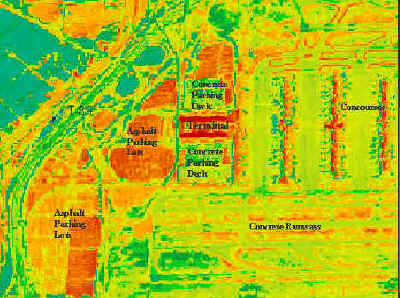
Using high resolution,
infrared photography developed by NASA for research on Urban Heat
Islands, new strategies are emerging for improving the overall
environment of urbanized areas by
lowering ambient temperatures and reducing energy usage. The study of
Urban Heat Islands is an emerging science which during the last few
years has become the focus of major research projects at NASA, EPA and
DOE as well as respected universities. While more definitive studies are
continuing, it is clear from the data that the built environment, and
corresponding lack of vegetation, is several degrees warmer (2 to 10
degrees F) than nearby natural environments. Moreover, certain
structures, especially asphalt parking lots and dark roofs, are much
hotter and retain heat longer. Modeling suggests that by increasing the
reflectivity (albedo) of these surfaces, planting more trees, and
reducing the capacity of these structures to store heat, the high
ambient temperature can be reduced, providing many direct and indirect
benefits to the environment and our health.
|
|
|
Cool Communities Sustainable Design
"System"
Using all of these measures together as a
"system" greatly increases the effectiveness of heat island
mitigation. Strategies can be applied by planners and other
decision-makers to mitigate air quality degradation, improve water
quality and reduce stormwater runoff. These measures offer a
cost-effective and innovative approach to pollution prevention,
providing tremendous benefit for minimal cost. They are non-regulatory;
they do not require behavior modification, they can be
implemented for new development as well as introduced during retro-fitting
and normal maintenance cycles, plus they provide significant
ancillary benefits in energy savings and creating more
pleasant urban environments.
|
Conclusions and Implementation
Increasing reflectivity, reducing heat storage capacity, and more
extensive tree plants work together as a system and can be implemented
in a variety of ways. In general this would mean using lighter colored
roofing (with sufficient insulation), more tree planting and protection,
and the use of porous concrete and lighter colored paving instead of
standard asphalt for parking and driveway surfaces.
|
|
Cool Communities is a
non-profit action-oriented advocacy program aimed at improving urban
environments and conserving energy by promoting the use of lighter,
reflective (high albedo) roofing and paving materials in combination
with strategically planted shade trees as a desirable design
"system." In Georgia, Cool Communities has created public and
private partnerships in support of these efforts to mitigate the impact
of the Urban Heat Island.
Nationally the program is
sponsored by the U. S. Department of Energy and the U.S. Environmental
Protection Agency. Each "Cool Community" organization is
responsible for its own funding, generally through grants,
contributions, and foundation support.
For information on how to make
your community a "Cool Community," please contact us through
this web site. |
|